The 2022 eruption of the Mauna Loa volcano cut off road access to the Mauna Loa Baseline Observatory. Construction on the temporary Mauna Loa Access road was completed on 26 March, 2026.
At this time, there is no site access for the general public to the Mauna Loa Observatory and NOAA has not yet established a public opening date. GML and scientific partners are working together to bring mission critical scientific projects back online. It is still unclear when utility infrastructure will be replaced and power re-established to the site.
We will provide another update as more information becomes available.
Media contact: Theo Stein at (303) 819-7409 or theo.stein@noaa.gov.
Organization(s):
 NOAA FSL (National Forecast Systems Laboratory), GPS
Observing Systems Branch
NOAA FSL (National Forecast Systems Laboratory), GPS
Observing Systems Branch
What does this program measure?
Total Atmospheric Water Vapor
How does this program work?
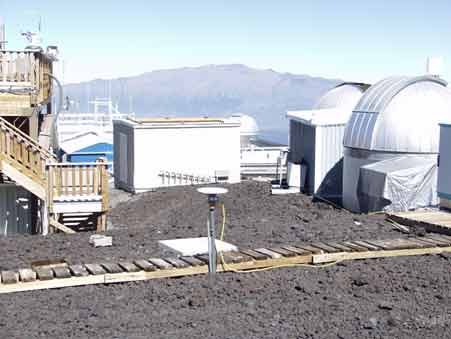
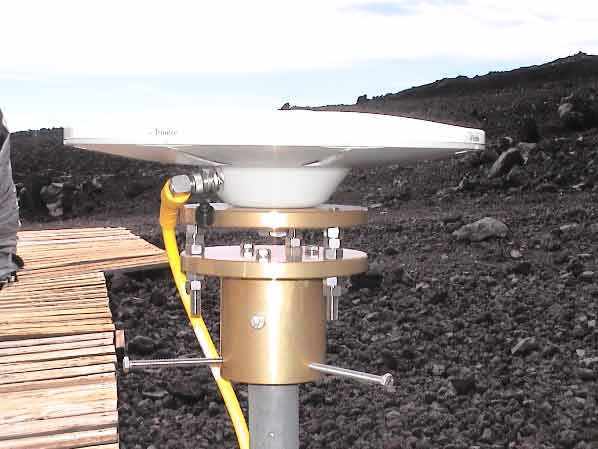
The dual frequency GPS receiver will continuously observe all satellites in view. Dual frequency carrier phase observations will be made very 30 seconds. Data will be transferred to the PC every 30 minutes. Quick-look displays will be created by Forecast Systems Laboratory (FSL) and will be available via the internet.
Why is this research important?
Global Positioning System Meteorology gives us the ability to measure the total quantity of water vapor in the atmosphere with unprecedented accuracy under all weather conditions. By continuously monitoring the ratio of integrated precipitable water vapor (IPW) at MLO to three nearby stations at or near sea level, we can evaluate short and long-term changes in the mean temperature of the atmosphere above 600 h Pa.
Are there any trends in the data?
How does this program fit into the big picture?
What is it's role in global climate change?
Comments and References
Lead Investigator(s):
Seth I. Gutman
303-497-7031
Kirk Holub
303-497-6642
MLO Contact(s):
Darryl Kuniyuki
808-933-6965 (x236)
David Nardini
808-933-6965 (x229)
Web Site(s)
http://www.fsl.noaa.gov/
projects/observing.html
Date Started
2005
Related Programs
Photographs: