The 2022 eruption of the Mauna Loa volcano cut off road access to the Mauna Loa Baseline Observatory. Construction on the temporary Mauna Loa Access road was completed on 26 March, 2026.
At this time, there is no site access for the general public to the Mauna Loa Observatory and NOAA has not yet established a public opening date. GML and scientific partners are working together to bring mission critical scientific projects back online. It is still unclear when utility infrastructure will be replaced and power re-established to the site.
We will provide another update as more information becomes available.
Media contact: Theo Stein at (303) 819-7409 or theo.stein@noaa.gov.
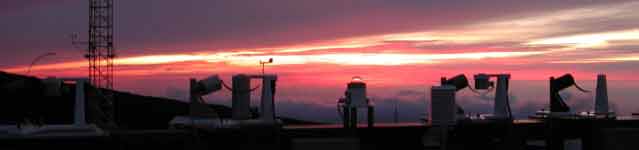
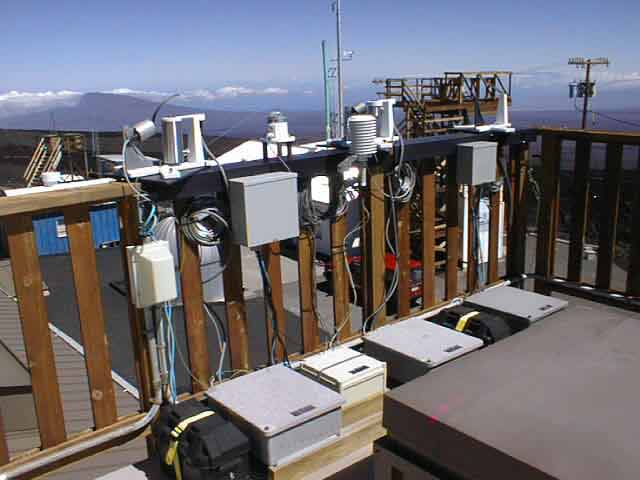
Solar Sensors at MLO sunset (courtesy of Forrest M. Mims III)
Organization(s):
 United States Department Of Agriculture (USDA)
 Colorado State University (CSU) / Natural Resource Ecology
Laboratory (NREL)
Colorado State University (CSU) / Natural Resource Ecology
Laboratory (NREL)
What does this program measure?
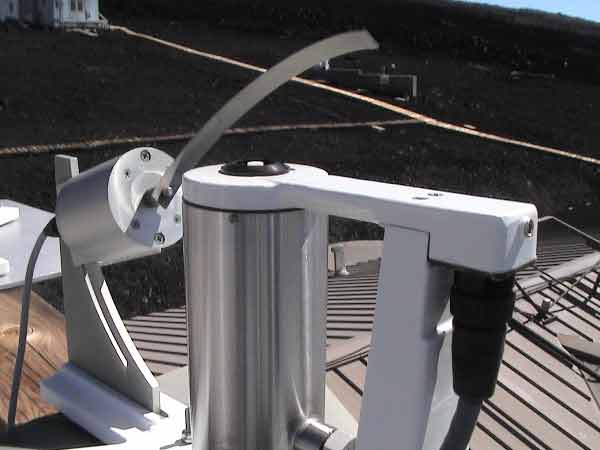
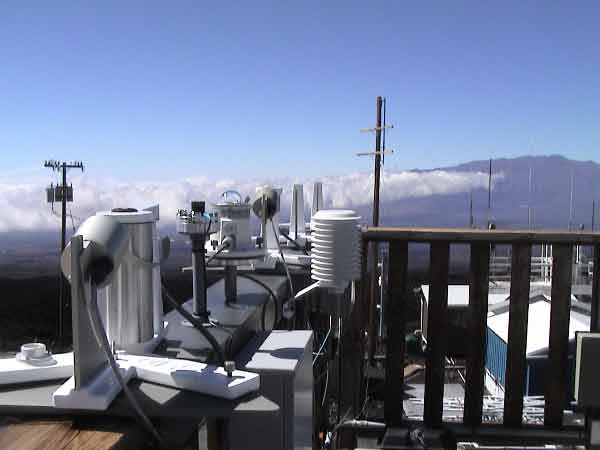
The USDA’s Cooperative State Research, Education and Extension Service (CSREES) is supporting research and monitoring programs to determine the potentially damaging long-term and short-term effects of enhanced UV-B ultraviolet radiation on agricultural crops and forests. As part of this research initiative, Colorado State University (CSU) is establishing a nationwide surface UV-B monitoring program. It measures primarily ultraviolet radiation, 300-368nm, with multiple instrumentation spanning 280-940nm, in units of Watts/meter^2/nm.
How does this program work?
With a network of 32 sites in USA [29], Canada [2], and New Zealand [1], located primarily in rural areas, with particular consideration given to agricultural and forested regions. Our web site gives details about the variety of instrumentation we are using [view web site].
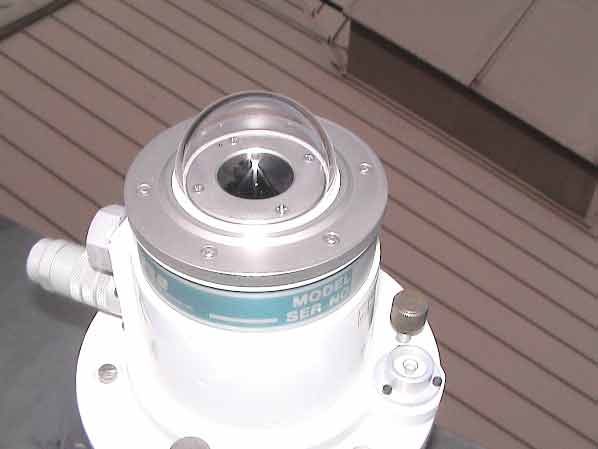
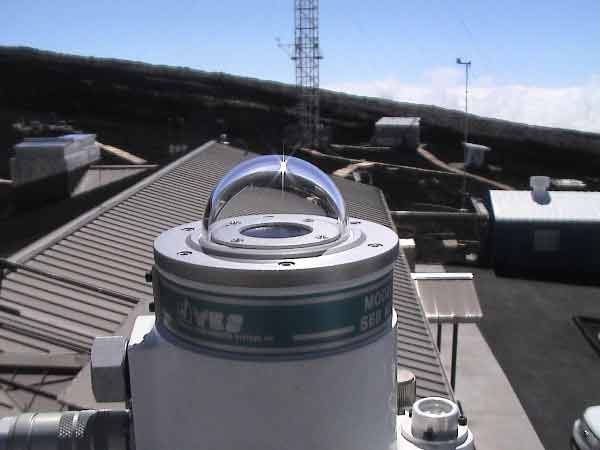
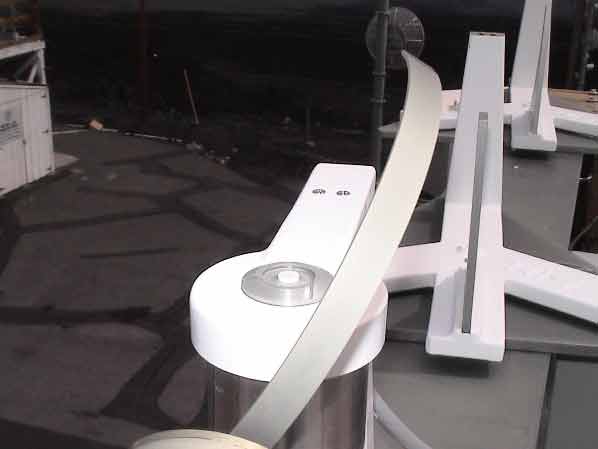
Instrumentation consists of seven-wavelength (300, 305, 311, 317, 325, 332, and 368 nm) 2nm FWHM filter shadowbanded radiometer to measure total horizontal, diffuse, and direct normal irradiance. This is similar to visible MFRSR. The instruments are operated and data is acquired over a phone line.
Why is this research important?
In order to provide information on the geographical distribution and temporal trends of UVB radiation in the United States. This information is critical to the assessment of the potential impacts of increasing ultraviolet radiation levels on agricultural crops and forests.
Are there any trends in the data?
Our usable UV data begins in 1998, so we don't yet have sufficient baseline data to reliably determine any trends. In the meantime, we have a wide range of UV impact research problems being addressed by the Impact Group coordinated by Dr. Wei Gao. We have developed extensive collaboration and interaction with researchers in agriculture, natural resources, and science communities, some of whom are addressing trends. Many of our current research projects using this UV data are ongoing, long-term projects.
How does this program fit into the big picture?
What is it's role in global climate change?
A 3-Dimensional model was developed to predict the UV-B and UV-A irradiance for horizontal surfaces in open canopies. The model can serve as a much needed tool to examine UV loading of people and other life in and below tree and other vegetation canopies.
Comments and References
Lead Investigator(s):
Dr. James R. Slusser
970-491-3623 (3601)
Bill Durham
970-491-3604
MLO Contact(s):
Paul Fukumura
808-933-6965 (x223)
Web Site(s)
http://uvb.nrel.colostate.edu/UVB/
http://www.nrel.colostate.edu
Date Started
November, 1997
Related Programs
Photographs: