The 2022 eruption of the Mauna Loa volcano cut off road access to the Mauna Loa Baseline Observatory. Construction on the temporary Mauna Loa Access road was completed on 26 March, 2026.
At this time, there is no site access for the general public to the Mauna Loa Observatory and NOAA has not yet established a public opening date. GML and scientific partners are working together to bring mission critical scientific projects back online. It is still unclear when utility infrastructure will be replaced and power re-established to the site.
We will provide another update as more information becomes available.
Media contact: Theo Stein at (303) 819-7409 or theo.stein@noaa.gov.
Organization(s):
 National Oceanic and
Atmospheric Administration (NOAA),
National Oceanic and
Atmospheric Administration (NOAA),
Earth System Research Laboratory (ESRL)
What does this program measure?
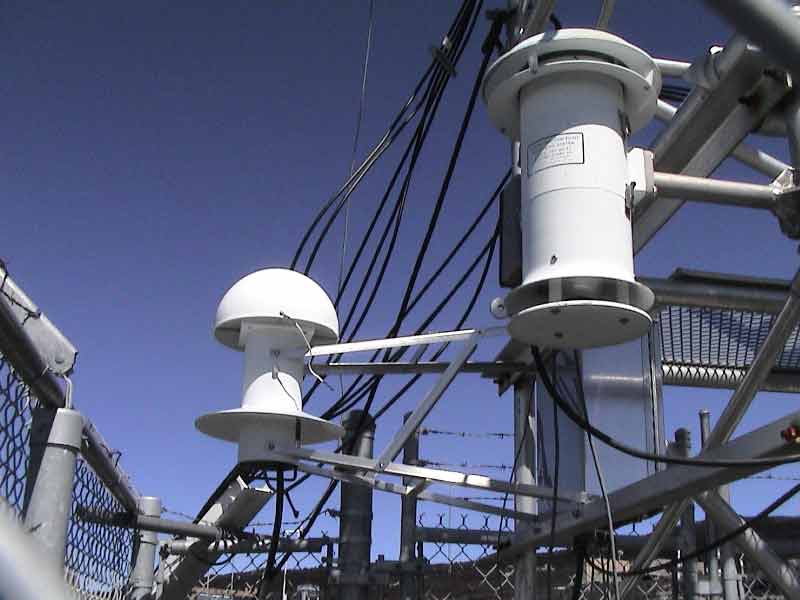
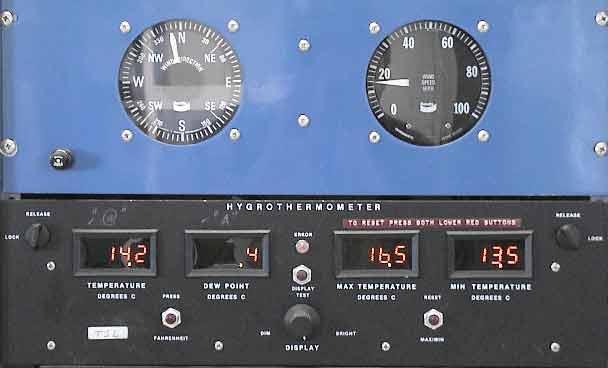
The ESRL GMD Meteorology program measures ambient and dewpoint temperatures, relative humidity, precipitation (in inches), and wind speed and direction.
How does this program work?
The dewpoint hygrothermometer measures ambient and dewpoint temperatures, from which relative humidity is calculated. Precipitation is continuously measured (in inches) with a tipping bucket.
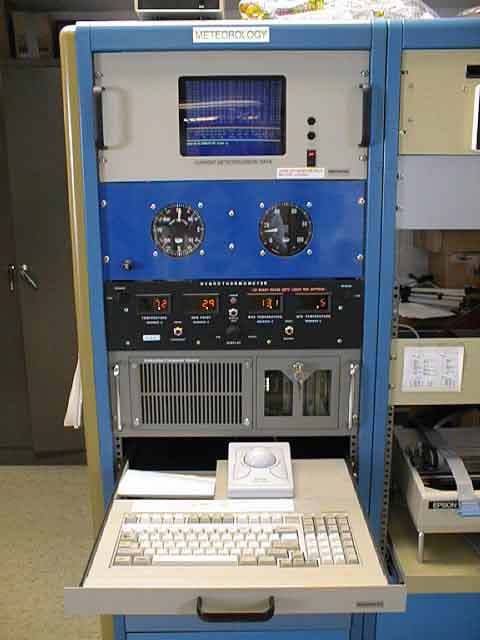
A Mauna Loa PC based system utilizes RS-485 serial communications to collect data from the instruments. The data is recorded as one minute averages, except for precipitation. Precipitation is measured as a daily total accummulation.
| Measurement | Instruments | Frequency |
|---|---|---|
| Air Temperature | Aspirated thermistor, 2m, 9m, 37mm heights | continuous |
| Air Temperature | Max/Min thermometers, 2-m height | daily |
| Temperature gradient | Aspirated thermistor, 2m, 9m, 37m heights | continuous |
| Dew point temperature | Dew point hygrometer, 2m height | continuous |
| Relative Humidity | TSL 2m height | continuous |
| Pressure | Capacitance Transducer | continuous |
| Pressure | Mercurial barometer | 5/week |
| Wind (speed and direction) | 10m, and 38m heights | continuous |
Why is this research important?
In order to monitor the trends in meteorological parameters, and to assist in the interpretation of other parameters such as aerosols.
Are there any trends in the data?
Day rose and night rose (below) show the wind direction at the observatory. Note that the night rose shows
only the southerly component which is the desired downslope conditions.


MLO press and MLO temps (below) is the running record since 1977. There is a slightly increasing trend in the
ambient temperature since 1977.


How does this program fit into the big picture?
What is it's role in global climate change?
It allows us to see how changes in other atmospheric variables affect the meteorology of the station.
Comments and References
Lead Investigator(s):
Thomas Mefford
303-497-6051
MLO Contact(s):
Matthew Martinsen
808-933-6965(x223)
Paul Fukumura
808-933-6965 (x223)
Web Site(s)
http://www.esrl.noaa.gov/
gmd/dv/met/mlo.html
Date Started
1977
Related Programs
Photographs: