More than two years after road access and electrical power to the Mauna Loa Observatory was cut off by lava flows, NOAA staff continue to make critical measurements of the atmosphere and other environmental variables at the remote site.
In 2023, observatory staff installed solar panels at the site and resumed some measurements, including the independent carbon dioxide monitoring programs run by the Global Monitoring Laboratory and Scripps Institution of Oceanography, as well as other atmospheric measurements.
Construction of a temporary road to access the observatory site is anticipated to begin in summer 2025.
Media can contact: Theo Stein (303) 819-7409 (theo.stein@noaa.gov)
Organization(s):
 National Oceanic and Atmospheric Administration
(NOAA), Earth System Research Laboratory (ESRL)
National Oceanic and Atmospheric Administration
(NOAA), Earth System Research Laboratory (ESRL)
 Network For the Detection of Atmospheric Composition Change
(NDACC)
Network For the Detection of Atmospheric Composition Change
(NDACC)
 National Institute of Water and Atmospheric Research
(NIWA)
National Institute of Water and Atmospheric Research
(NIWA)
What does this program measure?
The Bromine Oxide (BrO) monitor measures the zenith skylight between 340 and 390 nm. This instrument is also used to monitor Chlorine Dioxide (OCLO).
How does this program work?
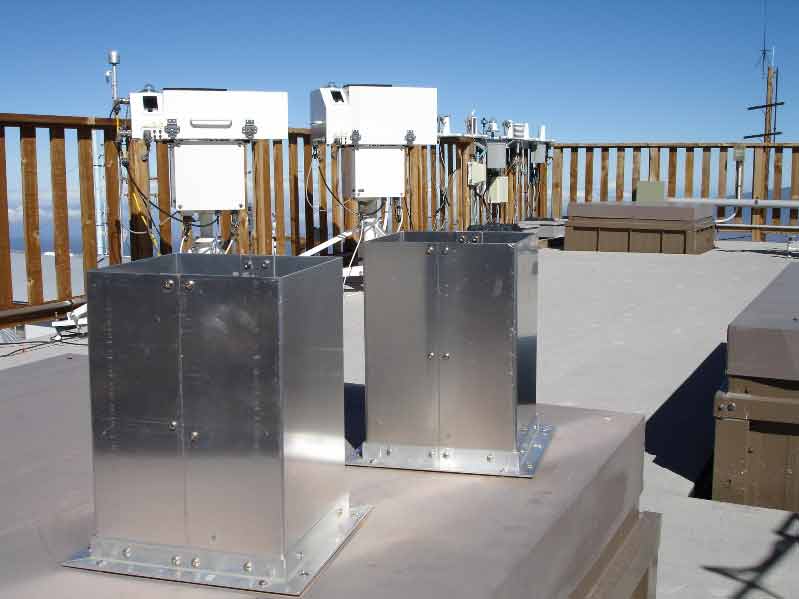
Shown Below, the Nitrogen Dioxide and Bromine Oxide sensor covers on the Mauna Loa Sun Deck, where solar radiation is measured.
Why is this research important?
In order to carry out continuous monitoring of BrO at MLO.
Are there any trends in the data?
How does this program fit into the big picture?
What is it's role in global climate change?
Comments and References
Lead Investigator(s):
Paul V. Johnston (NIWA)
011-643-440-0429
MLO Contact(s):
Paul Fukumura
808-933-6965 (x223)
Dr. John E. Barnes
808-933-6965 (x222)
Web Site(s)
www.niwa.co.nz
gml.noaa.gov/grad/
uv.html
Date Started
July 9, 1996
Related Programs
Photographs: