


HCFC-142b (Chlorodifluoromethane)
There are two GML programs that measure HCFC-142b. The longest and most complete measurement of HCFC-142b is from the HATS flask GC-MSD program (data displayed below). The CATS in situ GCs also measure HCFC-142b, however the data are less precise than the flask measurements. For further information on HCFCs click here.
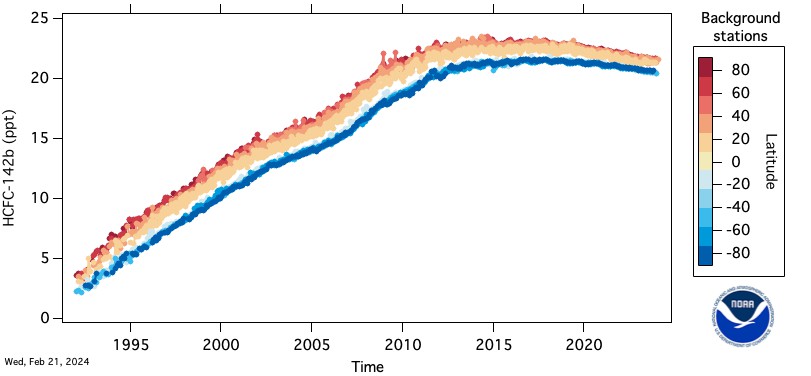
Atmospheric dry mole fractions (parts-per-trillion or ppt) of HCFC-142b measured by GC-MSD in the HATS flask program. Each point represents a monthly mean at one of 8-12 stations: Alert, Canada (ALT), Summit Greenland (SUM), Barrow, Alaska (BRW), Mace Head, Ireland (MHD), Trinidad Head, California (THD), Niwot Ridge, Colorado (NWR), Cape Kumukahi, Hawaii (KUM), Manua Loa, Hawaii (MLO), American Samoa (SMO), Cape Grim, Australia (CGO), Palmer Station, Antarctica (PSA), South Pole, Antarctica (SPO).
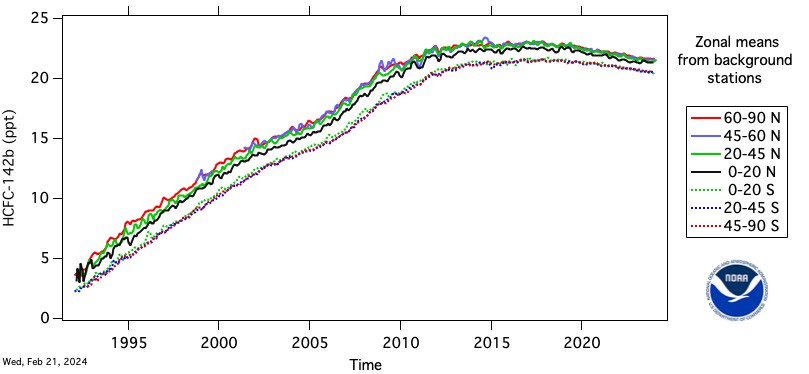
Zonal mean dry mole fractions (ppt) are estimated from the flask data by equally weighting monthly mean measurements in each latitude band. Small gaps (less than 6 months) are interpolated prior to averaging. Solid lines are used for Northern hemispheric measurements and dashed for the Southern hemisphere.
Selected Publications
- Montzka, S. A., B. D. Hall, and J. W. Elkins (2009), Accelerated increases observed for hydrochlorofluorocarbons since 2004 in the global atmosphere, Geophys. Res. Lett., 36, L03804, doi:10.1029/2008GL036475.
- Montzka, S.A., R.C. Myers, J.H. Butler, and J.W. Elkins, Early trends in the global tropospheric abundance of hydrochlorofluorocarbon-141b and -142b, Geophys. Res. Lett., 21, 2483-2486, 1994.